Mod Noise
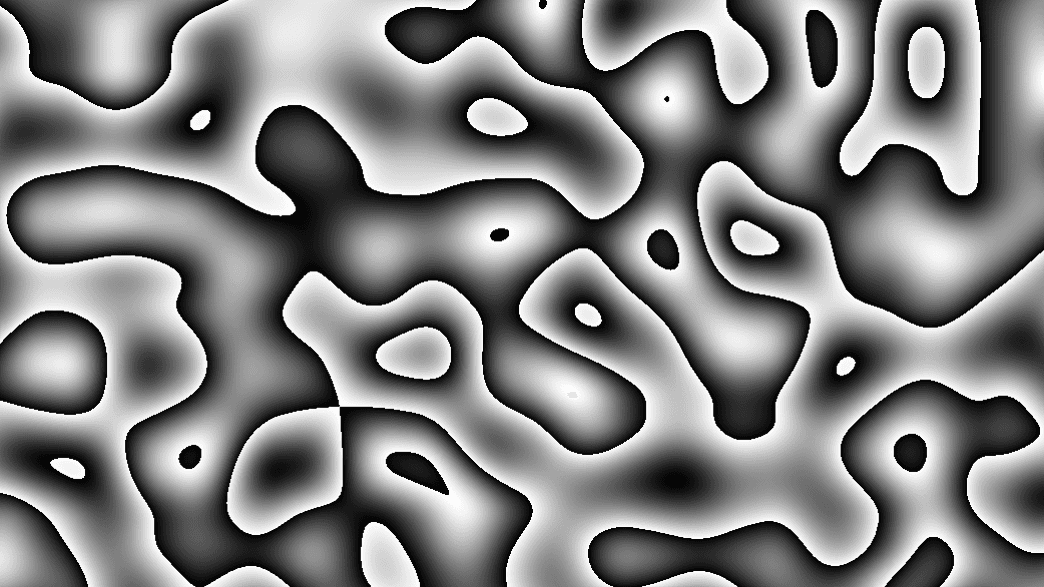
Smooth noise passed through a modulo, turning its level sets into hard contour bands that flow with the field.
The Mod Noise node takes a smooth noise field and wraps its value with a modulo. Every wrap becomes a hard edge, so the output is a set of contour bands that move with the noise underneath.
- One texture output; a Displace input and a Composite Input
- One control of its own, Bands, plus the shared transform, shaping, and speed blocks
- Found in the node graph under Generators; the search presets Contour and Strata place it pre-set
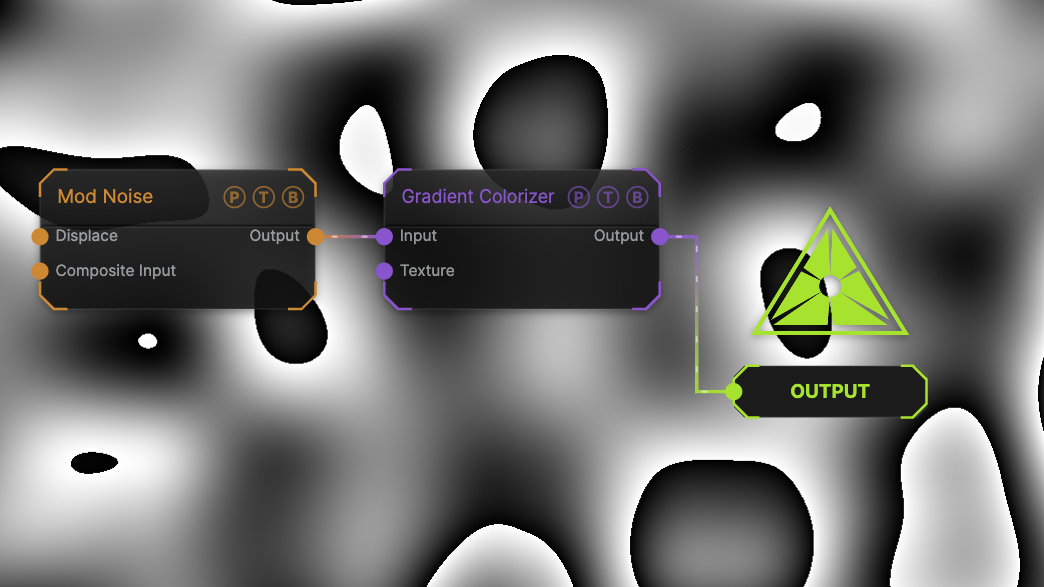
The image on the right is the example patch itself. Drag and drop it onto the app, or load it with File → Load, to open the full graph. It uses the Contour settings through a Gradient Colorizer.
Inputs and outputs
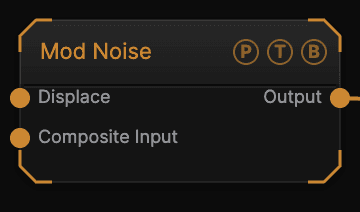
| Port | Type | Purpose |
|---|---|---|
| Displace | Texture | Domain warp: the red and green channels push the sample coordinates by Displace Amount. |
| Composite Input | Texture | Composited under the output with Composite Mode and Composite Mix, which appear once the port is wired. |
| Output | Texture | The grayscale field, 0–1. Each band ramps from black to white and wraps. |
Parameters
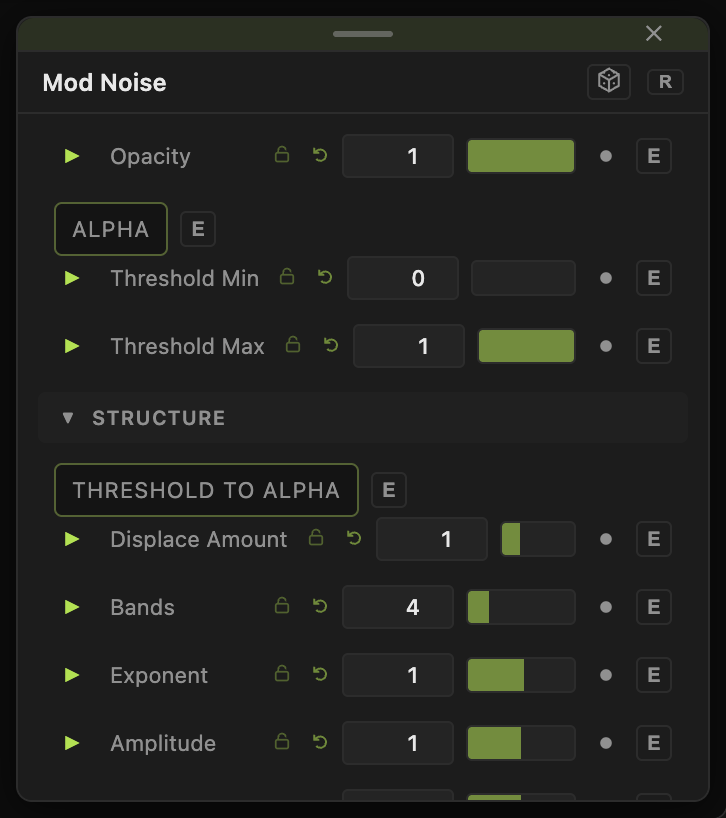
Opacity, Blend Mode, Alpha, Invert Alpha, Threshold Min / Threshold Max, Threshold To Alpha are the standard generator header; see Perlin Noise.
Structure
- Bands (1–16, default 4) — how many times the field wraps across its range. Low values give wide terrain-like contours; high values give dense fringes.
Transform and value
- Seed, Scale (default 1), Scale X / Scale Y (default 5), Offset X / Offset Y, Rotation — the shared transform block.
- Exponent (0.1–8, default 1), Amplitude (0–2, default 1), Offset (0–1, default 0.5) — value shaping, applied to the wrapped output.
- Displace Amount (0–4, default 1) — strength of the Displace input.
- Speed (0–5, default 1) — evolution rate; the bands flow as the noise evolves. 0 freezes them.
Every slider has a per-parameter animation bar. See Parameters and Controls.
Examples
Contour — Bands 3, Scale X / Y 3. Wide terrain contours.
Strata — Bands 12, Scale X / Y 2.5. Dense interference fringes.
Topographic lines — Bands 6, then a Threshold with a narrow Between range to keep only the wrap edges.
Troubleshooting
Bands flicker at high counts — the wrap edges alias when they are thinner than a pixel. Lower Bands or raise the render resolution.
No visible bands — Amplitude is near 0 or Bands is 1. Bands only appear when the field crosses a wrap.