Mesh to SDF
Bakes a surface mesh into a distance field so real geometry can join an SDF chain.
Mesh to SDF is the bridge from the surface family into the SDF family. Wire a mesh in and its baked distance field behaves like any primitive: union it, repeat it, hollow it, or displace it.
- Takes a Surface mesh; outputs an SDF
- The same Position / Rotation / Scale and morph block as SDF Primitive
- Found under SDF → Model in the operators panel
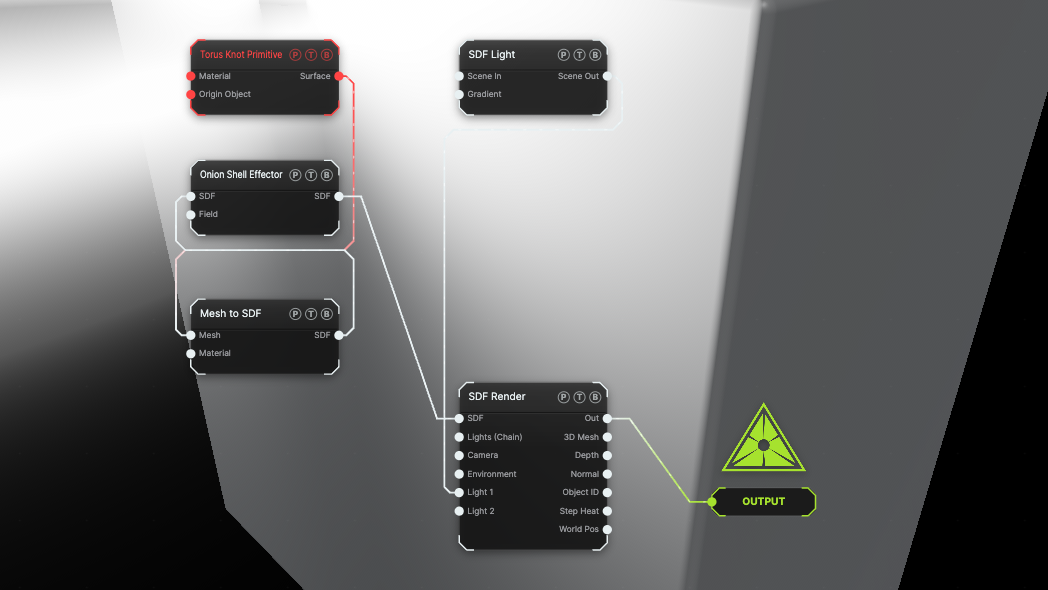
The image on the right is the example patch itself. Drag and drop it onto the app, or load it with File → Load, to open the full graph. A surface Torus Primitive is baked, then hollowed with an Onion Shell effector.
Inputs and outputs
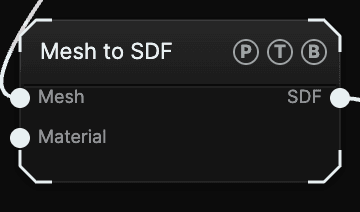
| Port | Type | Purpose |
|---|---|---|
| Mesh | Surface | A surface Primitive, an Extrude, a polygonized SDF from SDF Render's 3D Mesh output, or a Merge of those. A merged assembly bakes as one field. |
| Material | SDF | An SDF Material for the baked shape. |
| SDF | SDF | The baked field. |
Parameters
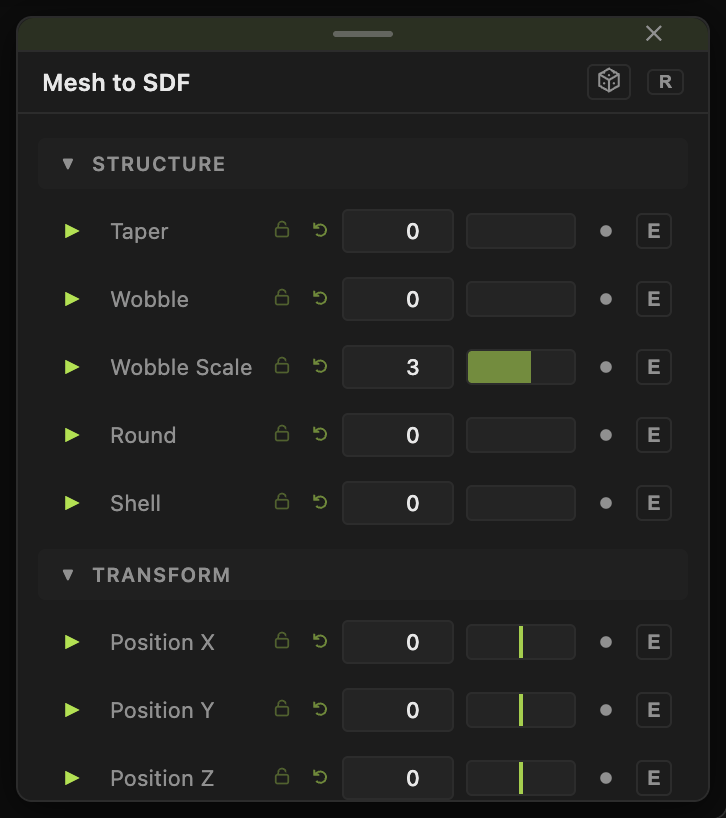
- Position X / Y / Z, Rotation X° / Y° / Z°, Scale — placement of the baked field.
- Taper, Wobble, Wobble Scale, Wobble Speed, Round, Shell — the same morphs a primitive has, applied to the baked shape.
The bake itself has no controls. It runs at a fixed 64³ resolution in the background, and the node shows Baking mesh distance field… until it lands. Baked fields are cached, so changing the transform never rebakes.
Examples
Model in a lattice — a surface Torus Knot into Mesh to SDF, then SDF Combine Smooth Union with a Gyroid primitive.
Infinite knots — Mesh to SDF into an SDF Effector set to Grid Repeat.
Troubleshooting
Detail is lost — the bake grid is 64³, so thin features can vanish. Scale the source up before baking, or add a Round to thicken it.